
What Are Mutations in Grow a Garden?
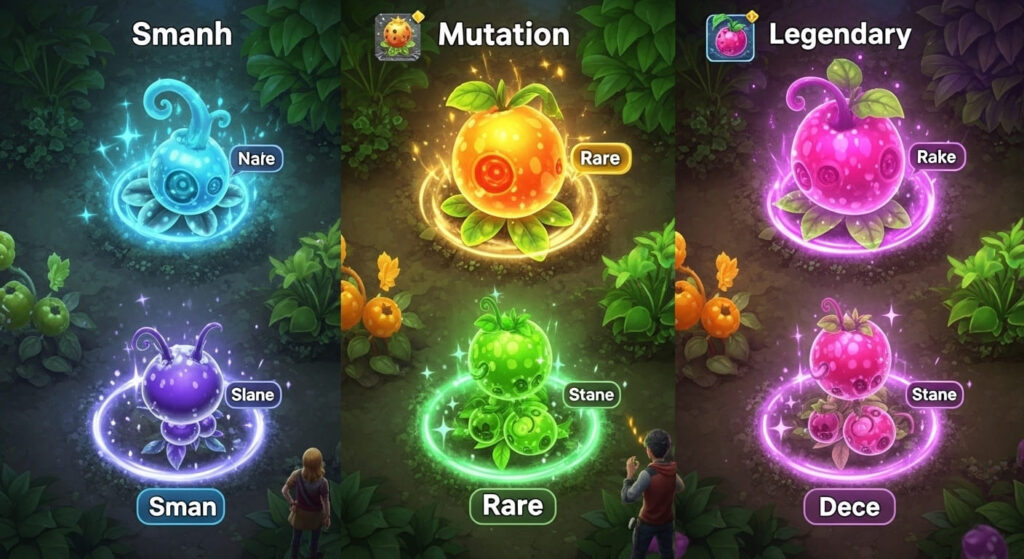
In Grow a Garden Mutation, a mutation is a random upgrade that enhances a plant’s value, appearance, or performance. These upgrades are driven by an RNG (Random Number Generation) system, meaning every harvest has a chance to produce a stronger version of the plant.
A mutated plant can have:
- Higher selling value
- Faster growth speed
- Unique visual traits
- Increased rarity tier
In simple terms, mutations turn normal farming into high-reward strategy gameplay.
Why Mutations Matter in the Game Economy
Mutations are the backbone of progression in Grow a Garden. Players who focus on mutation farming earn significantly more rewards than those who only harvest basic crops.
Key Advantages
- 💰 Higher profit per harvest
- ⚡ Faster progression through farming cycles
- 🌱 Access to rare and legendary plants
- 🏆 Competitive edge in advanced gameplay
Real Scenario
A player farming normal crops might earn steady income.
A player farming mutated crops can multiply profits 2x–5x or more over time.
Types of Mutations Explained
Not all mutations are equal. Understanding mutation tiers helps you decide what to aim for.
Mutation Types Overview
| Mutation Type | Effect | Value Multiplier | Difficulty |
|---|---|---|---|
| Common | Minor boost | 1.2x | Easy |
| Rare | Improved traits | 2x | Medium |
| Epic | Strong upgrades | 3x | Hard |
| Legendary | Unique and powerful | 5x+ | Very Hard |
What Changes in a Mutation?
- Size of the plant
- Growth duration
- Selling price
- Visual variation
The higher the tier, the greater the impact.
How Mutation Chances Work (Probability Explained)
Mutations are based on probability, not luck alone.
Every time you harvest a plant, the game performs a mutation check using RNG. The more farming cycles you complete, the more chances you get.
Key Principle
👉 More cycles = more mutation opportunities
Factors That Influence Mutation Chance
- Crop type
- Farming frequency
- Replant speed
- Use of boosters
- Garden layout
Important Insight
Many players think mutations are purely random.
In reality, consistent farming increases probability over time.
How to Get Mutations Fast (Step-by-Step Method)
Follow this process to maximize mutation chances:
Step 1: Choose High-Yield Crops
Focus on crops that grow quickly and provide good returns.
Step 2: Use a Structured Layout
Plant crops in a grid pattern to maintain efficiency and consistency.
Step 3: Farm in Continuous Cycles
Never leave your garden idle. Keep planting, harvesting, and replanting.
Step 4: Harvest at the Right Time
Avoid delays. Each delay reduces your total mutation attempts.
Step 5: Replant Immediately
Instant replanting increases total cycles per session.
Best Mutation Strategy (Beginner to Advanced)
Beginner Strategy
- Use fast-growing crops
- Focus on learning farming cycles
- Avoid using rare boosters early
Mid-Level Strategy
- Start targeting higher-value crops
- Improve layout efficiency
- Track your mutation results
Advanced Strategy
- Focus on legendary mutation farming
- Optimize cycles using timing
- Use boosters strategically
- Analyze farming patterns
Mutation Farming Framework (Decision System)
Use this framework to decide your approach:
| Your Level | Strategy | Goal |
|---|---|---|
| Beginner | Fast farming | Increase attempts |
| Intermediate | Balanced farming | Improve mutation rate |
| Advanced | Target farming | Maximize rare mutations |
Decision Rule
- If you lack mutations → increase cycles
- If you get low-value mutations → change crops
- If you get consistent mutations → scale strategy
Best Crops for Mutation Farming
Not all crops perform equally.
Ideal Crop Characteristics
- Fast growth cycle
- Good base value
- High replant frequency
Why Fast Crops Work Best
They give more mutation rolls in less time.
Using Tools and Calculators for Optimization
To improve efficiency, many players use tools like a Grow a Garden calculator.
Benefits of Using Tools
- Predict farming outcomes
- Optimize planting strategy
- Estimate total cycles
- Improve yield planning
These tools help turn random gameplay into a data-driven system.
Common Mistakes That Reduce Mutation Chances
Avoid these if you want better results:
- ❌ Waiting too long to harvest
- ❌ Random planting layout
- ❌ Ignoring farming cycles
- ❌ Using boosters too early
- ❌ Farming low-value crops
Key Insight
Most failures happen due to inefficiency, not bad luck.
Pro Tips to Increase Mutation Rate
- ✔ Focus on short farming cycles
- ✔ Maintain continuous activity
- ✔ Replant instantly after harvest
- ✔ Stick to one strategy instead of switching often
- ✔ Track your performance
Advanced Tip
Consistency beats randomness in the long run.
Mutation vs Normal Farming (Comparison)
| Factor | Normal Farming | Mutation Farming |
|---|---|---|
| Profit | Low | High |
| Speed | Medium | Fast (with strategy) |
| Difficulty | Easy | Moderate |
| Growth Potential | Limited | Unlimited |
When Should You Focus on Mutations?
Early Game
Focus on learning farming basics.
Mid Game
Start targeting rare mutations.
Late Game
Fully optimize for legendary mutations.
Is Mutation Farming Worth It?
Yes—mutation farming is the most efficient way to progress.
Pros
- High rewards
- Scalable strategy
- Competitive advantage
Cons
- Requires consistency
- Needs time investment
- RNG factor still exists
Real Strategy Loop (Advanced System)
Use this loop for maximum efficiency:
- Plant fast crops
- Harvest quickly
- Replant instantly
- Track results
- Adjust crop selection
- Repeat
This loop creates a continuous optimization cycle.
FAQs
1. What is the best mutation in Grow a Garden?
Legendary mutations are the best because they offer the highest value and strongest upgrades.
2. How do I increase mutation chances?
Increase farming cycles, use efficient layouts, and replant quickly after harvesting.
3. Are mutations random or predictable?
Mutations are random, but consistent farming increases your overall probability.
4. Which crop is best for mutation farming?
Fast-growing crops are best because they allow more mutation attempts.
5. Do boosters guarantee mutations?
No, boosters improve chances but do not guarantee results.
6. Why am I not getting mutations?
You may have low farming cycles, inefficient layout, or slow replanting.
7. How long does it take to get a rare mutation?
It depends on your farming efficiency. More cycles reduce the time needed.
Conclusion
Mutations are not just about luck—they are about strategy, consistency, and optimization.
If you want to progress faster in Grow a Garden, focus on:
- Increasing farming cycles
- Using structured layouts
- Choosing the right crops
- Staying consistent
The players who succeed are not the luckiest ones—they are the most efficient.